HYROX 2026/27 Rules Update: What Changed, and What It Means for Indian Athletes
HYROX has published its General Rules and Conduct for the 2026/27 season, and a few of the additions are worth an Indian athlete's attention before race day. A plain-language summary of what changed, and what it means if you train in India for a race abroad.
“Don't Hesitate, Do It": Lynn's One-Week Fitness Vacation in Ladakh
Lynn had one week off between work projects in Singapore and wanted a break that was also active. She had always wanted to see Ladakh. This is her week there, in her own words, including how the altitude was handled.
Five Days, Zero Rest: What My Own Training Load Looks Like, and Why I Am Stopping
Yesterday I wrote that a coach looking at my file would prescribe a rest day. Then I did a strength session and a two hour run instead. Here is the full five day load table, the one measurement that genuinely improved, and an honest account of a coach not following his own protocol.
77 Watts at 135 Beats: Why Cycling Power Measures Altitude Better Than Running Pace
Power cannot be blamed on a hill or a headwind, which is why the morning ride made the cleaner headline. But the evening run was the session that actually taught me something: ten beats per minute higher and thirty six seconds per kilometre slower than the day before. Both files, published in full.
Zone 2 at 3,259 Metres: Why I Ran Two Minutes Faster on Day Three, and Why That Is Not Progress
Day two: 10'44" per km. Day three: 8'48" per km. It looks like a spectacular adaptation and it is nothing of the sort. Here are both files side by side, the four things that actually explain the gap, and the one number that did genuinely improve.
I Tested My Blood on Day Three at Altitude. This Is the Baseline I Will Be Judged Against
A baseline taken after you have already adapted is worthless. So on my third morning in Leh, before altitude has had time to change anything, I walked into a lab and had my blood drawn. Haemoglobin 14.25 g/dL, PCV 43.50%, red cell count 5.07. Here is the full starting line, published ahead of the September retest.
Can You Train on Your Second Day in Leh? A Measured Answer From 3,302 Metres
I drove from Rishikesh to Leh over two days, then ran for an hour at 3,302 metre the next morning. My blood oxygen read 97%, a sea-level number. My pace was three and a half minutes per kilometre slower than easy. Here is the full file, and why a good oxygen reading is not permission to train.
What to Pack for a Residential Fitness Programme in India
This is the actual list we send our guests, built from five years of watching what people bring and what they wish they had. Almost everything on it is here because somebody once turned up without it and had a worse month for it.
What You Actually Eat on a Four-Week Residential Programme
Most people arrive braced for hunger, and the first surprise of the month is how much food turns up. Cooked vegetarian meals planned around what you trained, why restriction backfires, and where the real difficulty in Indian vegetarian eating actually sits.
A Day Inside a Residential Fitness Programme
The most surprising thing about a good residential day is how unremarkable it looks. No punishing dawn session, no shouting, and most of the day is not training at all. Here is the shape of a day, and more usefully, why each block sits where it does.
What Does a Residential Fitness Programme in India Actually Cost?
Residential fitness programmes in India run from roughly a lakh to well over ten, and almost nobody publishes what the number includes. How the pricing works, where the extra costs hide, and the one question that produces a real total.
How to Choose a Weight Loss Camp in India: 7 Questions to Ask
Every weight loss camp in India looks identical from the outside. Mountains, a group photo, a promise, a price. Seven questions that sort a serious programme from a nice hotel with a treadmill, in about ten minutes on a phone call. Including our own answers.
Which Doctor Should I See? A Guide to 22 Common Health Conditions
Knowing which doctor to see is a skill, and almost nobody is taught it. A plain map of 22 common conditions: who to see first, which specialist handles it, when to escalate, and the signs that mean going to hospital now.

The 8 HYROX Stations Explained: Weights, Order, and Technique
Every HYROX race in the world is identical. All eight stations explained in order, with official weights and a full technique guide for each.

HYROX Running: Pace, Compromised Runs, and Weekly Volume
HYROX is a running race with stations attached. The fastest athletes are not those who run the fastest first kilometre, but those whose eight runs look identical.

First HYROX at 45, Top 16 Percent: How a British Athlete Trained in India
He did not drive across town to train. He flew from the United Kingdom to India and stayed twelve weeks, only for the program and his first HYROX. Here is what his blood and his race showed, told honestly.

HYROX Wall Balls: Weights, Technique, and Break Strategy (Station 8)
The station with the widest time gap in the race. Three to four minutes separate elite from recreational, and it is decided by rhythm, not strength.

HYROX Sandbag Lunges: Weights, Technique, and Strategy (Station 7)
The station that asks most of your legs. Why the standard advice to pace it is wrong, and the stride adjustment that protects your wall balls.
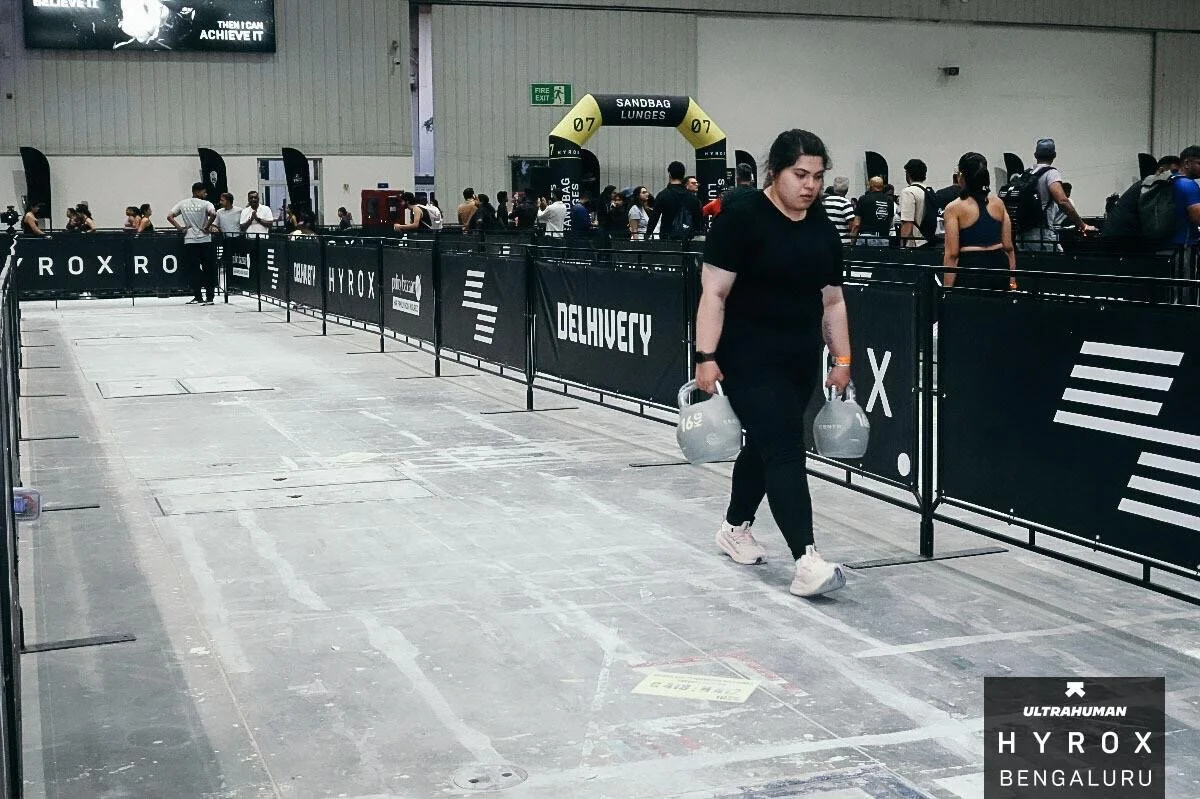
HYROX Farmers Carry: Weights, Grip, and Strategy (Station 6)
The simplest station in HYROX, and one of the most deceptive. Almost nobody gains time here, but a single drop costs 15 seconds you cannot get back.

HYROX Rowing: Damper, Technique, and Pacing (Station 5)
Rowing 15 to 20 seconds slower than your maximum can save your whole race. Damper settings, the drive sequence, and why restraint is speed on station 5.