First HYROX at 45, Top 16 Percent: How a British Athlete Trained in India
From the UK to Rishikesh · HYROX case study
Robert Townson did not drive across town to train. He flew from the United Kingdom to India, and stayed for twelve weeks. He came for one reason: a residential HYROX preparation and health transformation in Rishikesh. We measured his blood the whole way, and it ended in his first ever HYROX race, in Bengaluru, finished inside the top 16 percent. A month later, back home in the UK, he was on a podium at an obstacle race, which is the part that matters most. This is what a British athlete travelled nearly 7,000 km for, told honestly.
Most fitness stories in India run the other way, with people travelling abroad for retreats. This one runs inward. It is also proof-led rather than photo-led: we publish physiology and a public race result, because both can be checked and a photograph cannot.
Not a straight line, and we say so. Atherogenic lipids improved sharply in camp, drifted up while he was home in the UK over New Year, and were being re-corrected in the second block. Two findings, a red cell distribution width that rose and stayed up, and a mild liver-enzyme rise on the latest panel, were referred to a doctor. The honest detail is below.
- Why a British athlete flew to India to train
- Why we publish biomarkers, not photos
- The program, and what each panel captures
- How to read the panels against the timeline
- Lipids and cardiovascular risk
- Blood sugar
- Testosterone and thyroid
- Micronutrients
- Blood count and iron
- Liver, kidney, inflammation
- The two findings we referred out
- What we are still working on
- The tape measured it, too
- What the timeline teaches
- The point of it all: his first HYROX
- What happened next, back home
- Frequently asked questions
- About the coach
Why a British Athlete Flew to India to Train
Robert Townson is from the United Kingdom. He could have trained in any of a thousand gyms at home, or flown somewhere sunny for a soft wellness week. He did neither. He booked a residential place in Rishikesh, in the foothills of the Himalayas, and travelled to India for one purpose: to prepare for his first HYROX and to reset his health under full supervision.
That is the part worth pausing on. Fitness tourism almost always flows out of India. Here it flowed in. A British athlete crossed nearly 7,000 km to spend twelve weeks in an Indian residential program, because what he wanted was not a view or a spa. It was structure, coaching, cooked meals, recovery, and accountability under one roof, with his blood measured to prove it was working.
He did it in two stays, either side of Christmas and New Year at home in the UK. That gap, as the blood shows later, turned out to be part of the lesson. But the headline is simple: this is a program good enough that people get on a plane for it.
Why We Publish Biomarkers, Not Photos
A photograph is real, but it is also the easiest thing in fitness to stage, light, and angle. More importantly, a photo cannot show whether things are getting better or worse under the surface: the number of atherogenic particles in the blood, how the body handles sugar, hormone levels, or the health of the red cells.
So we measure, and we measure more than once. A serious program should be able to show its work in numbers that cannot be lit or angled, tracked over time so the direction of travel is clear. This case study reports one man's blood work across three panels.
The Program, and What Each Panel Captures
Robert flew in from the United Kingdom at 44 and left at 45, having spent twelve weeks in residence across two blocks, with a trip home to the UK in between. He came only for this: the training, the HYROX preparation, and the health reset. The three blood panels line up almost exactly with that structure, and his first HYROX race sits at the end of it. Reading the numbers against the timeline is the whole point.
| Stage | Dates | Blood panel |
|---|---|---|
| Block one (India), check-in | 12 Oct 2025 | Panel 1, arrival baseline (13 Oct) |
| Block one, check-out | 9 Nov 2025 | Panel 2, end of block (8 Nov) |
| Flew home to the UK | Dec 2025 to early Feb 2026 | New Year, off-program |
| Block two (India), check-in | 15 Feb 2026 | Panel 3, mid-block (14 Mar) |
| Block two, check-out | 9 Apr 2026 | End of HYROX-specific block |
| Race day (India) | 12 Apr 2026 | HYROX Bengaluru 2026, first race |
| Back home in the UK | 10 May 2026 | Nuclear Rush obstacle race, 2nd in age group |
So Panel 1 is where he arrived, Panel 2 is after four weeks of a structured residential block, and Panel 3 is roughly four weeks into the second block, after his months back home in the UK. All samples were processed by the same NABL and CAP accredited reference laboratory, read against that laboratory's own reference intervals. Published with written consent.

The training was HYROX-specific and hands-on. Every station he would meet on race day, he drilled at camp, under coaching, in the structured environment the blood work was there to support.

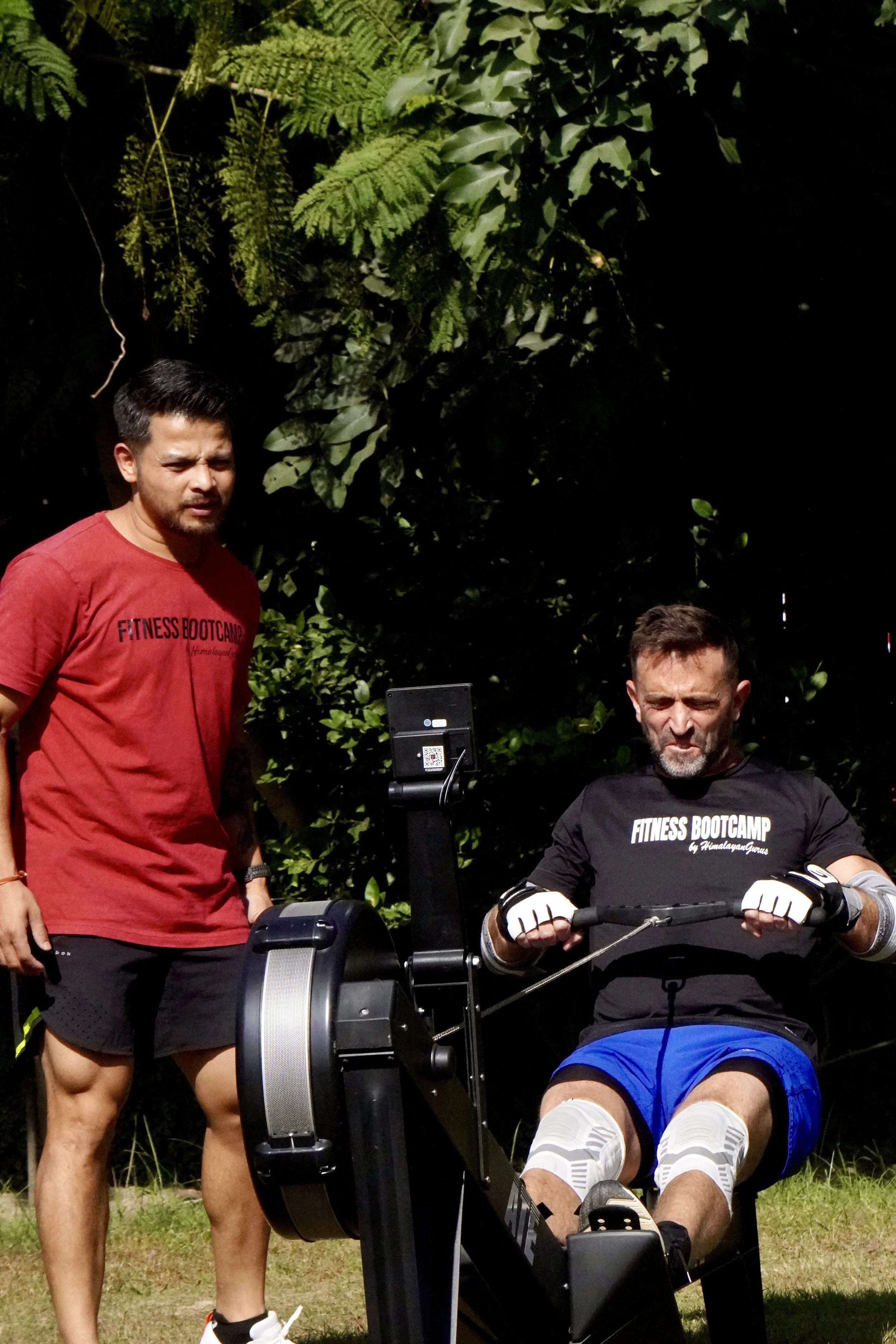

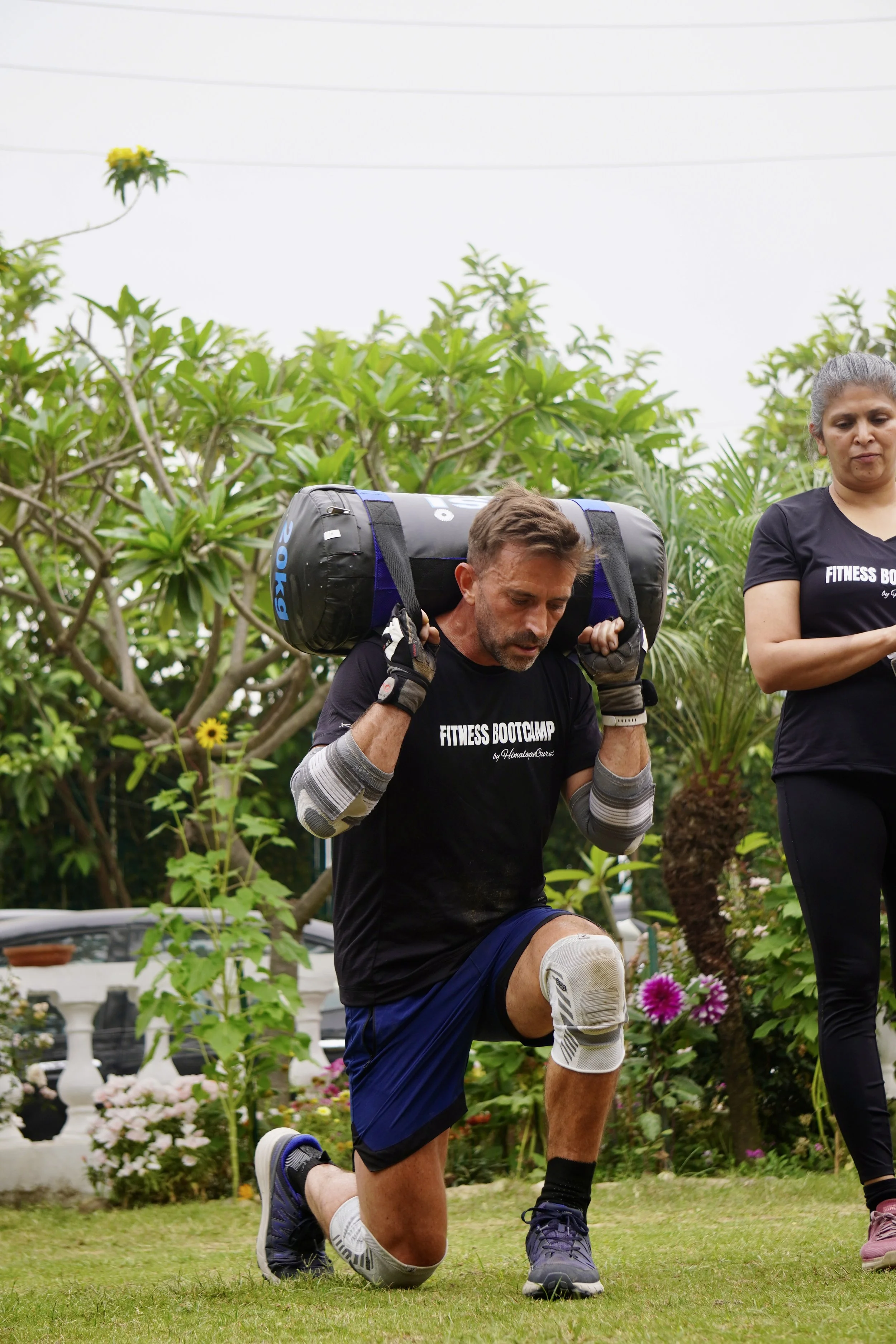

Drilling the stations at camp: SkiErg, row, sled push, sandbag lunges, and wall balls, the movements the blood work was supporting.
How to Read the Panels Against the Timeline
The value of testing at these points is that each marker can be read against what was happening in Robert's life. A jump between the arrival and end-of-block panels reflects the first residential block. A drift between the end-of-block and mid-second-block panels spans the holiday, when the structure was not there. And a marker still moving on the third panel is one the second block is actively working on.
This also shows why testing more than once matters. A raised red cell distribution width would look like a random blip on a single panel. Across three, we can see it was normal on arrival, rose by the end of the first block, and stayed up in the second, which turns a maybe into a clear reason to see a doctor.
Being clear about scope is part of the honesty. These panels track blood markers only. They do not include body composition or measurements, and they describe one person. What they show well is a trend, read against a known timeline, and the judgement of which trends belong with a coach and which belong with a doctor.
Lipids and Cardiovascular Risk
This is the most interesting trend, because it did not move in a straight line.
| Marker | 13 Oct | 8 Nov | 14 Mar | Reference |
|---|---|---|---|---|
| Triglycerides (mg/dL) | 50 | 53.5 | 73 | <150 |
| Total cholesterol (mg/dL) | 200.9 | 158.9 | 170 | <200 |
| HDL-C (mg/dL) | 57.7 | 53.9 | 51 | >40 |
| LDL-C (mg/dL) | 133.2 | 94.3 | 120 | <100 |
| Non-HDL-C (mg/dL) | 143 | 105 | 119 | <130 |
| Apolipoprotein B (mg/dL) | 107.9 | 73 | 93 | 60 to 140 |
| ApoB : ApoA1 ratio | Not run | 0.55 | 0.72 | <0.98 |
| hs-CRP (mg/L) | 0.83 | 0.88 | 0.80 | <1.0 |
This is the clearest example of the timeline in the blood. LDL cholesterol and apolipoprotein B, which counts the number of atherogenic particles in the blood, were borderline-high when Robert arrived. Across the first four-week residential block they improved sharply, with LDL falling from 133 to 94 and ApoB from 108 to 73. Over the weeks back home in the UK that followed, they drifted part of the way back, and the March panel, taken four weeks into the second block, shows them mid-correction at 120 and 93. Triglycerides stayed low throughout and inflammation stayed low on all three panels. Apolipoprotein B is now considered a more accurate marker of cardiovascular risk than LDL cholesterol on its own, and in the INTERHEART study across 52 countries the ApoB-to-ApoA1 ratio was the strongest lipid-related predictor of heart attack. Against the Lipid Association of India targets, these numbers are a continued focus rather than a solved problem. Note that the March LDL was measured directly while the earlier two were calculated, so small method differences apply. The laboratory's own curated summary of the arrival panel independently flagged the same raised total cholesterol, LDL, non-HDL, and HbA1c, a useful second read from a separate source.
Blood Sugar
| Marker | 13 Oct | 8 Nov | 14 Mar | Reference |
|---|---|---|---|---|
| HbA1c (%) | 5.8 | 5.6 | 5.7 | <5.7 |
| Estimated average glucose (mg/dL) | 120 | 114 | 117 | From HbA1c |
| Fasting glucose (mg/dL) | Not run | 68.5 | 71.2 | 70 to 100 |
HbA1c reflects roughly the previous three months of blood sugar. It moved from 5.8 at baseline, into the non-diabetic range at 5.6, then back to 5.7, which sits right on the prediabetes threshold. Fasting glucose was healthy. The honest read is that his blood sugar is close to the line and worth keeping an eye on, rather than clearly one side or the other. There is one caveat covered in the referred-out section: because HbA1c depends on red-cell turnover, and this panel carries a red-cell flag, the exact figure is best confirmed once that is understood.
Testosterone and Thyroid
| Marker | 13 Oct | 8 Nov | 14 Mar | Reference |
|---|---|---|---|---|
| Testosterone, total (ng/dL) | 479.0 | 426.1 | 569.1 | 175 to 781 |
| Testosterone, free (pg/mL) | 23.30 | 19.25 | 27.60 | 9.57 to 40.60 |
| TSH (µIU/mL) | 1.50 | 1.39 | 2.22 | 0.27 to 4.20 |
| Free T4 (ng/dL) | Not run | Not run | 1.53 | 0.93 to 1.70 |
| Free T3 (pg/mL) | Not run | Not run | 2.84 | 2.00 to 4.40 |
Total and free testosterone eased slightly during the first residential block, which can happen with a heavier training load, then rose to their highest reading by the second block, a healthy trend for a man in his mid-forties. Thyroid function was comfortably within range at every timepoint, with a full free-thyroid panel on the last draw confirming it. These are steady, reassuring results.
Micronutrients
| Marker | 13 Oct | 8 Nov | 14 Mar | Reference |
|---|---|---|---|---|
| 25-OH Vitamin D (nmol/L) | 92.8 | 96.0 | 126.3 | 75 to 250 |
| Vitamin B12 (pg/mL) | Not run | 331 | 410 | 211 to 946 |
Vitamin D was sufficient at every panel and rose to a comfortable level by March, which matters because deficiency is common and quietly affects bone, muscle, and immune function. B12 moved from the low-normal end up into a healthier position. Both are moving the right way.
Blood Count and Iron
| Marker | 13 Oct | 8 Nov | 14 Mar | Reference |
|---|---|---|---|---|
| Red cell distribution width (%) | 13.7 | 18.6 | 17.3 | 11.6 to 14.0 |
| Haemoglobin (g/dL) | 13.3 | 13.3 | 14.4 | 13.0 to 17.0 |
| MCHC (g/dL) | 30.6 | 31.1 | 30.8 | 31.5 to 34.5 |
| MCV (fL) | 96.4 | 92.4 | 93.6 | 83.0 to 101.0 |
| Total leukocyte count (thou/mm³) | 5.69 | 3.87 | 4.83 | 4.0 to 10.0 |
| Platelets (thou/mm³) | 290 | 296 | 301 | 150 to 410 |
| Serum iron (µg/dL) | Not run | 110.9 | 150.2 | 65 to 175 |
| Transferrin saturation (%) | Not run | 43.4 | 48.7 | 20 to 50 |
Haemoglobin improved to mid-range by March, and iron was replete throughout. The finding that needs a doctor is the red cell distribution width, a measure of how much red-cell size varies. It was normal at baseline, rose sharply on the second panel, and stayed high on the third, with MCHC sitting just below range each time. Because iron looked replete, the simple explanation does not fit neatly. This is discussed in the referred-out section below.
Liver, Kidney, Inflammation
| Marker | 13 Oct | 8 Nov | 14 Mar | Reference |
|---|---|---|---|---|
| ALT / SGPT (U/L) | 23.7 | 24.8 | 53.2 | <50 |
| AST / SGOT (U/L) | 27.5 | 24.1 | 31.3 | <50 |
| GGT (U/L) | 32.9 | 14.3 | 16.1 | <55 |
| ALP (U/L) | 44.2 | 50.7 | 54.5 | 30 to 120 |
| Albumin (g/dL) | 4.31 | 4.35 | 4.79 | 3.50 to 5.20 |
| Creatinine (mg/dL) | 0.80 | 0.76 | 0.85 | 0.67 to 1.17 |
| eGFR | 111 | 113 | 109 | >59 (G1) |
| Uric acid (mg/dL) | 5.73 | 3.88 | 3.95 | 3.50 to 7.20 |
Kidney function was strong at every panel, albumin rose, and uric acid improved. Liver enzymes were normal on the first two panels. On the March panel, ALT rose just above range at 53.2, while AST, GGT, ALP, and bilirubin all stayed normal and albumin was healthy. An isolated ALT rise like that is usually mild and often temporary, and it is the second thing we referred out rather than interpreting ourselves.
The Two Findings We Referred Out
A careful program is defined as much by what it does not claim as by what it reports. Two findings here belong with a doctor, and the reasoning we can share stays inside its limits.
Normal, then raised, then still raised
This measures how much red-cell size varies. It was normal in October, rose to 18.6% in November, and stayed high at 17.3% in March, with MCHC just below range each time. Iron was replete and B12 was fine, so the simplest cause does not fit cleanly. Seeing it appear and persist across three panels is exactly why serial testing is worth doing, and it is a clear reason for a doctor's review rather than a coaching guess.
An isolated ALT rise on the latest panel
ALT rose just above range on the March draw, while every other liver marker stayed normal and albumin was healthy. An isolated ALT rise is commonly mild and often temporary, with causes that include recent intense exercise. The right next step is a repeat panel after a period of rest, ideally with a creatine kinase test, to confirm it. That stays outside coaching scope.
What We Are Still Working On
- Atherogenic lipids. LDL and ApoB improved sharply, then drifted back up. Bringing them down and holding them there is the main lipid goal.
- HbA1c at the edge. It has hovered around the 5.7 prediabetes line. Nutrition and training aimed at glucose handling stay a focus.
- HDL. It has drifted down slightly across the panels, though it remains above range.
- A doctor's review of the red-cell finding and the ALT rise before anything else.
- Folate and ferritin added, to help interpret the red-cell picture.
- Lipoprotein(a) and homocysteine, to refine cardiovascular risk given the lipid drift. The laboratory's own report suggested these too.
- A rested draw, 48 to 72 hours clear of hard training, so the liver enzymes reflect his rested state.
- Body composition paired with the bloods, so the physical and the physiological can be read together.
The Tape Measured It, Too
We do not judge the body by eye. We measure it. Across the first four-week block, girths were taken at check-in and again near check-out, recorded and countersigned by Robert and his coach. Here is what four weeks changed.
| Site (cm) | 12 Oct | 7 Nov | Change |
|---|---|---|---|
| Hip | 106 | 101 | -5.0 |
| Belly, relaxed | 99 | 94.5 | -4.5 |
| Belly, exhale | 103 | 99 | -4.0 |
| Belly, inhale | 91 | 87.5 | -3.5 |
| Chest | 102.5 | 101 | -1.5 |
| Right thigh | 56.5 | 55.5 | -1.0 |
| Left thigh | 56.5 | 55.5 | -1.0 |
| Neck | 40 | 39.5 | -0.5 |
| Right arm | 34 | 34.5 | +0.5 |
| Left arm | 34 | 34.5 | +0.5 |
The pattern is the useful part. In four weeks his hip and waist came down, close to 5 cm at the hip and the relaxed waist, while both arms went up half a centimetre. Losing around the middle while holding or adding at the arms is what body recomposition looks like on a tape: fat coming off the trunk with muscle kept. And it lines up with the blood. The same four-week block that took centimetres off his waist is the one that dropped his LDL from 133 to 94 and his apolipoprotein B from 108 to 73.
Two honest limits. These are tape measurements, not weight or body-fat percentage, and they cover the first block only. But they are measured and signed, not eyeballed, and they tell the same story the blood does.
What the Timeline Teaches
The honest lesson here is not that the numbers went one way. It is that they followed the structure, and the structure was in Rishikesh. Inside the first residential block in India, the atherogenic lipids improved sharply. Back home in the UK over New Year, away from the program, they gave some of that back. Returned to camp in India for the second block, they were being pulled down again. The same environment, food, training, and accountability that produced the first gain is what the drift makes visible, because the drift happened the moment that environment was 7,000 km away.
This is why a serious program treats results as something to hold, not just reach. A four-week block can move a marker a long way. Keeping it there is the harder, longer work, and it is the reason the second block exists. That second block also had a specific target: a start line.
The Point of It All: His First HYROX
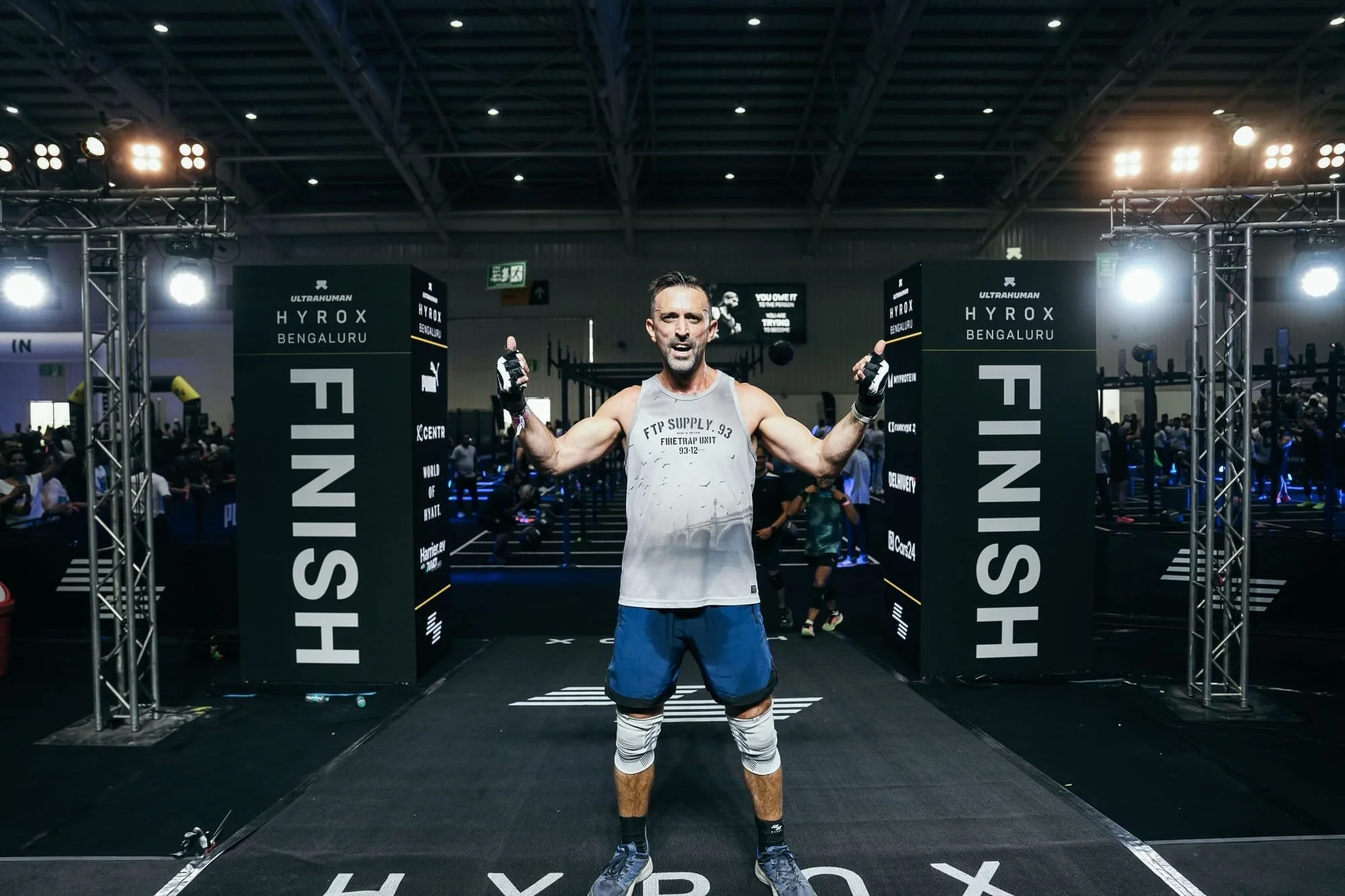
The blood work was never the goal. It was the instrument. Robert trained for HYROX specifically across both residential blocks, and on 12 April 2026, three days after checking out, he raced HYROX Bengaluru 2026, on Indian soil and under the British flag. It was his first ever HYROX.
| Result | Value |
|---|---|
| Finish time | 1:36:27 |
| Age group, men 45 to 49 | 15th |
| Overall placing | 288th of 1802 |
| Percentile | Top 16% |
| Running total | 47:40, average 5:58 per km |
| Stations total | 42:03 |
| Transitions (roxzone) | 6:44, 140th of 1802 |
For a first HYROX at 45, that is a strong debut. He placed 15th in the men's 45 to 49 age group and 288th of 1802 in the full men's field, inside the top 16 percent overall. The result is public and checkable, and the splits show exactly where it came from.
Where the time was won and lost
A HYROX is eight one-kilometre runs alternating with eight functional stations. Reading Robert's station ranks against the field shows a clear signature.
| Station | Time | Field rank (of 1802) |
|---|---|---|
| Farmers Carry | 1:43 | #18 |
| Sled Pull | 5:13 | #146 |
| Rowing | 5:01 | #191 |
| Sled Push | 3:21 | #212 |
| SkiErg | 4:49 | #279 |
| Sandbag Lunges | 5:56 | #397 |
| Wall Balls | 8:35 | #664 |
| Burpee Broad Jumps | 7:25 | #941 |
His strength and power-endurance stations ranked far above the field average. The Farmers Carry placed 18th of the whole men's field, and the sled pull, sled push, row, and SkiErg all landed well, which is what months of structured strength work look like on a race day. His transitions were sharp too, 140th of 1802 in the roxzone, the moving in and out of stations that quietly decides races. The two stations that punish first-timers, wall balls and burpee broad jumps, were his hardest, as leg and grip fatigue and pacing tend to be on a debut. His running, at an average of 5:58 per km, was steady rather than sharp, and since running is the single largest part of a HYROX, it is the clearest lever for next time. That is not a knock on the result. It is the honest map of where the next block of work goes.







From the race: sled push, SkiErg, row, sandbag lunges, and the finish. HYROX Bengaluru 2026.
In His Own Words
After the program and the race, Robert recorded his own reflection. It is his account, in his words, not ours.
Robert on his first HYROX at 45 and the program that led to it.
What Happened Next, Back Home
The real test of a residential program is not the last day. It is the first month after, when the structure is gone and the person is home alone with their habits. Robert flew back to the UK and kept the lifestyle he had built in Rishikesh: the training, the routine, the intent.
The proof came on 10 May 2026, less than a month after HYROX. He entered Nuclear Rush, a muddy obstacle course race on the Secret Nuclear Bunker estate in Essex, and stood on the podium.
| Result | Value |
|---|---|
| Event | Nuclear Rush, Essex, United Kingdom |
| Date | 10 May 2026 |
| Age group, men 45 to 49 | 2nd |
| Time | 1:39:09 |
It is worth setting this beside the earlier holiday drift, honestly. When he first went home mid-program, over Christmas and New Year, some of his markers slipped. By the end of the full twelve weeks, the habits had taken hold well enough that going home meant carrying on, not falling off. A first HYROX in India and an obstacle-race podium in the UK, five weeks apart, at 45, is what a lifestyle that actually transferred looks like. That, more than any single number, is the point of the program.
Coaching Scope Versus Medical Scope
We held a firm line throughout. Reading biomarkers to guide coaching is not the same as making a medical diagnosis. Trends in lipids, blood sugar, and micronutrients inform training and nutrition, which is coaching work. Findings such as a persistently raised red cell distribution width, or a liver enzyme above range, are flagged and referred to a qualified doctor. They are not diagnosed or treated by the coaching team.
- One participant. Nothing here generalises to typical results.
- Body data is limited. Tape girths were taken across the first block only, and they are circumferences, not weight or body-fat percentage.
- Not every marker was run every time, so some rows compare only two timepoints.
- Method differences, such as calculated versus direct LDL, mean small changes should be read with care.
- The latest liver enzymes and red-cell values need a rested repeat and a doctor's review before firm conclusions.
- Read for coaching, against one laboratory's reference intervals, not for diagnosis.
Frequently Asked Questions
Do people really travel from abroad to India for this?
Yes. Robert flew in from the United Kingdom and spent twelve weeks in residence in Rishikesh across two blocks, purely for the training, his HYROX preparation, and a supervised health reset. Fitness tourism usually flows out of India; this is a case of it flowing in.
Why track blood work more than once?
Because a single panel is a snapshot and cannot show direction. Testing across several months turns a one-off reading into a trend, which is what actually guides training and nutrition, and it catches findings a single test would miss.
Did everything improve in a straight line?
No, and that is the honest point. The atherogenic lipids improved sharply during the first residential block, gave some of it back over the off-program holiday, and were being re-corrected in the second block. Testosterone, vitamin D, B12, and haemoglobin moved up overall. Two findings were referred to a doctor. Real results follow the structure rather than a clean upward line.
What does a raised red cell distribution width mean?
It means red-cell size is varying more than usual, which can have several causes. Here it was normal at first, then rose and stayed up. That is a reason to see a doctor for a proper assessment, not something to interpret or treat on your own.
Is the race result real and checkable?
Yes. HYROX results are published publicly on HYRESULT. Robert's HYROX Bengaluru 2026 finish time, his eight station splits, his runs, and his age-group placing can all be looked up there by anyone.
Is this medical advice?
No. This is an educational case study about one person's blood work over time. Always consult a qualified doctor before starting any intensive program or interpreting your own results.
About the Coach

Niraj Kumar Borah
Founder and head coach of Fitness Bootcamp, a premium residential health transformation program based in Rishikesh. Since 2020 he has guided more than 4,600 guests, from across India and from abroad, through structured, fully supported transformations, with a biomarker-driven approach that measures outcomes rather than promising them.
His credentials include Precision Nutrition Level 1, VDOT Certified Running Coach, HYROX Academy Level 1 certified and an affiliated HYROX Performance Coach, Bioforce Conditioning Coach, Certified MMA Conditioning Coach, and NESTA Certified Heart Rate Performance Specialist.
These are coaching and conditioning credentials, not medical ones. Every clinical finding in this case study, such as the raised red cell distribution width and the liver-enzyme rise, was referred to a qualified doctor rather than diagnosed or treated by the coaching team.
Worth crossing a border for
A structured, fully supported residential transformation in Rishikesh, built on real measurement, for people who are serious enough to travel for it. Guests come from across India and beyond.
Message the team on WhatsAppConsent. Published with the participant's explicit, documented, informed written consent on file, held in line with India's Digital Personal Data Protection Act, 2023, with the right to withdraw. Medical disclaimer. For education only. Not medical advice, diagnosis, or treatment. Describes one person and does not represent typical results. Blood values came from a third-party accredited laboratory and were read for coaching and education. Any abnormal result here was, and any abnormal result you find should be, evaluated by a qualified doctor. Do not begin an intensive exercise or nutrition program without appropriate medical clearance.